The braking system of motorhomes and campervans is fundamental
Published on 28/08/2025
The braking system represents the most critical safety element for motorhomes and campervans, vehicles that can weigh up to 3.5 tonnes and require significantly longer stopping distances compared to traditional cars. The difference in weight and load distribution make a perfectly efficient braking system essential, especially during long journeys across Italy and Europe. The physics of braking in recreational vehicles is unforgiving: a fully loaded motorhome needs a stopping distance that can be double that of a normal car. This figure becomes even more concerning when we consider that, according to a GITNUX study, braking system malfunction is one of the causes of approximately 8% of accidents involving motorhomes. The research also highlights that on wet roads a motorhome’s braking distance increases by up to 30%, while at the same time the risk of failure due to component overheating grows.
Specific risks of braking in recreational vehicles The considerable mass of motorhomes poses particular challenges for the braking system. During mountain descents or emergency situations, the brakes must be able to dissipate large amounts of thermal energy. The resulting overheating can cause the phenomenon known as “fading”, which significantly reduces braking effectiveness at critical moments. Furthermore, the typical usage conditions of motorhomes – such as long journeys, variable loads, mountain routes and intense seasonal use – put considerable strain on the braking system, subjecting it to constant stress. For this reason, preventive maintenance is essential to guarantee the safety of all occupants. Brands such as RIDEX and Brembo offer high-quality solutions for brakes that can withstand these thermal and physical loads, ensuring optimal performance and reliability on the road.
Diagram of critical factors for braking in motorhomes
Analysis of the diagram shows how the considerable weight of motorhomes creates a cascading effect that amplifies all braking-related risks. Each factor is interconnected with the others, making a systemic approach to safety essential. Brembo’s PVT disc technology, with its 40% superior cooling, intervenes precisely to break this chain of risks at the source.
How to recognise warning signs The AUTODOC expert source points out: “Among the main symptoms of a braking system that requires attention are excessive vibrations when braking, reduced efficiency and increased braking distance, metallic noises coming from the wheel area, an abnormal response from the vehicle, which tends to veer during braking, as well as, of course, the possible illumination of the brake warning light.” Other signs not to be underestimated include a brake pedal that sinks too far or feels too hard, burning smells after intense braking, and traces of brake fluid under the vehicle. Early diagnosis of these problems can prevent dangerous situations and high repair costs.
The importance of quality components When it comes to replacing braking system components, choosing reliable products makes the difference between a safe journey and potential risks. Brake discs, in particular, must guarantee consistent performance even in the most demanding conditions. The company actively employs innovative technologies and solutions in the production of its Brembo brake discs: the components are protected against corrosion thanks to a UV-resistant surface coating and are fitted with PVT ventilation, which, according to the manufacturer’s research, guarantees 40% superior cooling compared to traditional ventilation. This advanced technology proves particularly advantageous for motorhomes, which often face long descents and demanding usage conditions. Improved heat dissipation keeps braking effectiveness constant and extends the lifespan of the components.
Preventive maintenance for safety To ensure optimal performance, the braking system of motorhomes requires more frequent checks compared to cars. It is recommended to check pad thickness, disc condition and brake fluid level every 10,000-15,000 kilometres or at least once a year.
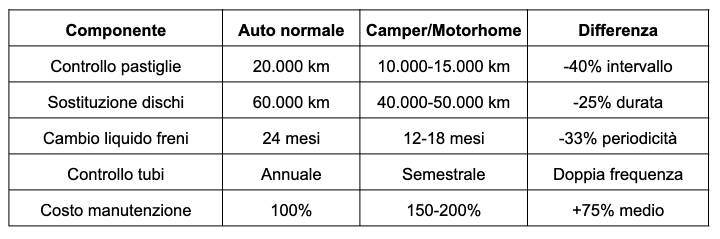
Comparison table: car vs motorhome brake maintenance
Motorhomes require 40% more frequent checks for pads and a maintenance expenditure that is 75% higher than for normal cars. This difference is justified by the vehicle’s double weight and the greater stresses placed on the braking components.
Replacing brake fluid takes on particular importance in recreational vehicles, since absorbed moisture can cause vapour to form during intense braking, seriously compromising the effectiveness of the system.
The study has shown that investing in preventive maintenance and quality components means protecting not only one’s investment, but above all the safety of those travelling. An efficient braking system is the fundamental prerequisite for enjoying the beauty of Italy and Europe on board one’s own motorhome with peace of mind. Sources:
GITNUX study on risk factors in recreational vehicle accidents
Brembo technical data and research on braking systems
AUTODOC - Centre of expertise for car and commercial vehicle spare parts
FAQ: on the braking system in motorhomes and campervans
Why is the braking system of a motorhome different from that of a car? The braking system of a motorhome is designed to support heavier vehicles with variable loads, which requires a more powerful and resistant system. Motorhomes require longer braking distances than cars, especially on mountain roads or wet surfaces.
What are the main risks related to braking in motorhomes? The considerable mass of motorhomes places greater stress on the braking system, especially during steep descents or sudden braking. The risk of “fading” increases due to component overheating, reducing braking effectiveness at critical moments.
How can I tell if my motorhome’s braking system needs maintenance? The most common signs include excessive vibration when braking, metallic noises coming from the wheels, an abnormal response from the vehicle that tends to veer, and the brake warning light coming on. If you also notice burning smells or traces of fluid under the vehicle, it’s time for a check-up.
Why is it important to choose high-quality components for the braking system? High-quality components such as those from RIDEX and Brembo ensure optimal thermal dissipation and greater wear resistance. This is essential for maintaining constant braking effectiveness and extending the lifespan of the system, especially under the strains of a recreational vehicle.
How often should I carry out maintenance on my motorhome’s braking system? Due to the greater weight and heavier use, the braking system of a motorhome requires more frequent checks than a car. It is recommended to check the pads, discs and brake fluid level every 10,000-15,000 km or at least once a year.
What are the additional costs related to motorhome brake maintenance? Motorhomes require more frequent brake maintenance, with a cost that can be up to 200% higher than for cars. This difference is mainly due to the greater weight and the more intense stresses placed on the components, making investment in preventive maintenance essential for safety.
for over 20 years Camperonline has offered all its services free of charge
thanks to the advertisers who have trusted us, please allow us to keep doing our work by disabling your ad blocker.


 App Camperonline