If your motorhome pulls to one side when braking, or you smell burning after a descent,
a brake calliper may be stuck.
It’s one of the most underestimated problems in heavy vehicles, and also one of the most dangerous on mountain roads.
Weight, heat and friction: why a motorhome’s brakes work twice as hard A motorhome weighs considerably more than an ordinary car. In some cases it exceeds 3,500 kg fully laden, and all that mass has to be stopped using the same braking system fitted to the base chassis. This means every braking action generates more heat, more friction and more stress on the components.
The two elements that work hardest are the brake discs and the brake callipers. The discs absorb and dissipate the heat produced by friction on a heavy vehicle, and this thermal cycle is far more intense than on an ordinary car. The brake callipers, for their part, clamp the pads against the disc to slow the vehicle down.
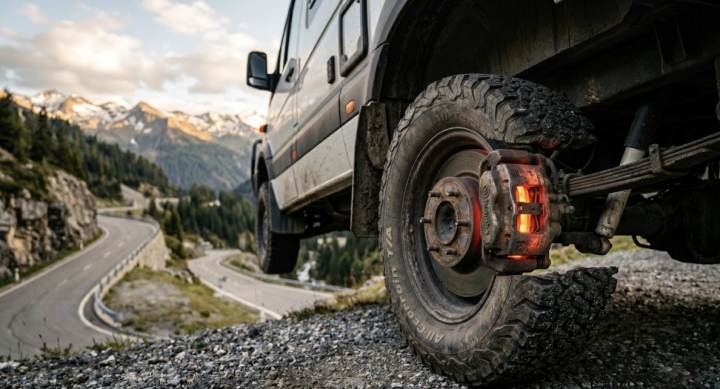
When working properly, they release fully as soon as the pedal is let go. If instead they remain partially closed, a phenomenon known as a “stuck” or “seized” calliper, the pads continue to rub against the disc even when the brakes aren’t being applied. Heat builds up, the disc can’t dissipate it fast enough, and the result is progressive overheating that can lead to the braking system failing.
What pushes brake callipers to their limit The weight of the vehicle is the main factor.
The more heavily laden the motorhome, the more energy the braking system has to dissipate. An overloaded vehicle—luggage, a full tank, bikes on the back—places disproportionate strain on the callipers.
Long descents are the second problem.
Many motorhome owners tend to brake continuously on mountain roads instead of using engine braking or changing down a gear. Engine braking slows the vehicle without generating heat in the discs, whereas repeated mechanical braking doesn’t give the components time to cool down.
Neglected maintenance completes the picture.
Brake callipers have internal pistons that need to slide freely. Over time, rust, dirt and oxidation can cause them to seize in position. If the vehicle stands unused for months—as is often the case with motorhomes used only seasonally—the risk increases considerably.
Degraded brake fluid is often overlooked.
Brake fluid is hygroscopic: it absorbs moisture from the air over time. When it contains too much water, its boiling point drops. In the event of overheating, the fluid can boil and form air bubbles in the circuit, and bubbles don’t transmit pressure. The pedal becomes spongy, and braking becomes unpredictable.
The signs that your braking system needs attention The warning signs are fairly clear, if you know what to look for.
Smell of burning after a descent or a stretch of motorway driving. It isn’t always the engine. If the smell is coming from a specific wheel, it’s almost certainly the brake.
The motorhome pulls to one side when braking. If the callipers are working asymmetrically—one stuck, the other not—the vehicle veers off course. This is a fault that needs correcting immediately.
Uneven pad wear. If, during an inspection, you notice that the pads on one side are far more worn than the other, the calliper on that side is probably not releasing correctly.
A wheel rim that’s hot to the touch. After a long stretch of driving, bring your hand close (without touching) to the rim. Excessive heat compared with the other wheels is a warning sign.
Resistance when accelerating. A stuck calliper creates constant friction. If the motorhome seems to “brake by itself” even on flat roads, this could well be the reason.
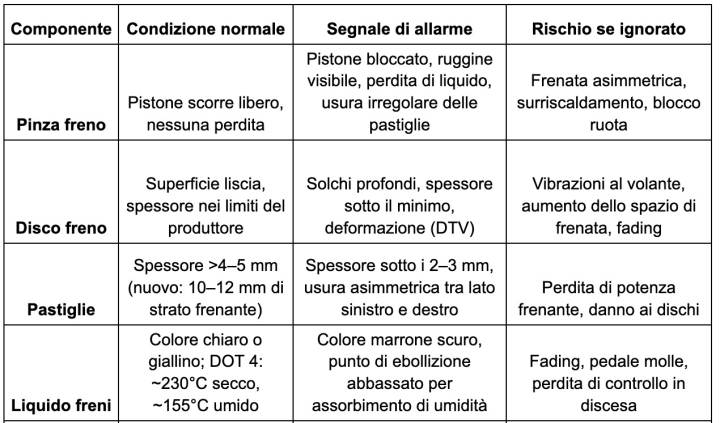
The table below summarises the normal state of each component, the warning signs not to ignore, and the concrete risks of neglected maintenance.
What really happens when the callipers fail on a mountain road A stuck calliper isn’t just a mechanical issue, it’s a direct safety risk.
Prolonged overheating can cause the brake discs to warp, losing their geometry and transmitting vibrations through the steering wheel. In extreme cases, the brake fluid can reach boiling point: at that point we speak of “brake fade”, where the pedal sinks to the floor without the vehicle slowing down effectively. On mountain roads, where descents are long and escape routes few and far between, this scenario can become extremely dangerous. It’s no coincidence that many serious accidents involving heavy vehicles occur precisely in situations of brake fade.
What’s worth checking before you set off Prevention is simple and doesn’t require any special tools.
Check the brake fluid. The colour should be clear or slightly yellowish. If it’s dark brown, it needs replacing. DOT 4 brake fluid, standard on most modern motorhomes, has a boiling point of around 230°C when new. As it absorbs moisture over time, that threshold drops considerably, and that’s exactly where the problems begin.
Visually inspect the callipers. Even without removing the wheel, it’s possible to check the discs through the spokes of the rim. A disc with deep grooves or a thick layer of rust is a sign of wear or a calliper not working correctly.
Check the thickness of the pads. New pads typically have 10–12 mm of friction material. Once they drop below 2–3 mm, they need replacing before the trip. Many have a visual wear indicator: if it’s flush, it’s best not to put it off.
Let the callipers move freely. Before a long trip, a few firm brake applications at low speed help to “wake up” the components, especially if the motorhome has been standing still. If you notice scraping or unusual resistance, have the system checked by a mechanic.
Use engine braking on descents. Changing down one or two gears before a long descent significantly reduces the workload on the mechanical brakes and lowers the temperature of the system.
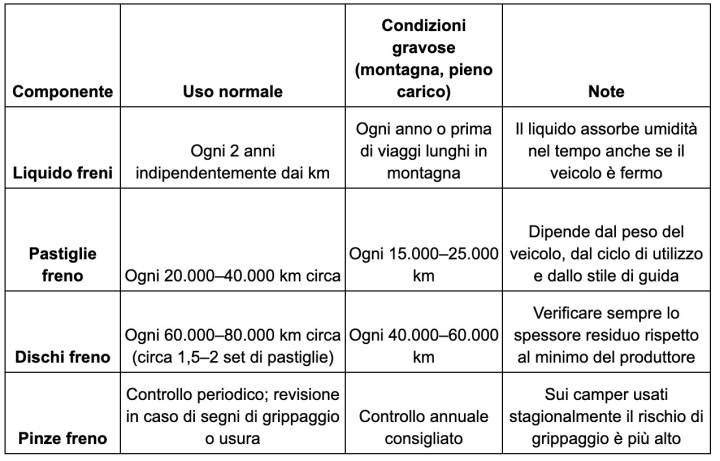
Knowing how often to intervene is just as important as knowing what to check. This table summarises the recommended intervals based on type of use, with specific attention to the conditions typical of motorhome travel.
When DIY isn’t enough If you notice even just one of the warning signs described above—burning smell, pulling to one side, uneven wear—don’t put off having it checked. A mechanic experienced with commercial vehicles or motorhomes can check the piston travel, measure the discs and assess the condition of the fluid in a matter of minutes.
Before taking the motorhome to the garage, it’s worth knowing in advance which components might be needed. On Autodoc Marketplace you can search for parts specific to your vehicle’s make and model—brake callipers, discs, pads and brake fluid—with the option to compare products from various selected sellers all in one place. For those who prefer to buy the parts in advance and take them directly to the mechanic, it’s a practical way to save time and keep costs under control.
The cost of a preventive check and a timely replacement is always far lower than that of a breakdown on the road or, worse still, an accident caused by an unreliable braking system.
Travelling by motorhome is one of the finest experiences there is. Just don’t neglect the components that let you stop when it matters.
for over 20 years Camperonline has offered all its services free of charge
thanks to the advertisers who have trusted us, please allow us to keep doing our work by disabling your ad blocker.


 App Camperonline