Rome is not the only place to experience the Jubilee. There are many great sanctuaries throughout Italy waiting to be discovered on the occasion of the holy year. Motorhomes and vans have become the ideal means of transport for modern-day pilgrims and for travellers seeking unconventional itineraries to reach these destinations, so characteristic of Italian culture and steeped in Christian history. A solution designed with inclusivity in mind, allowing even those who, due to physical limitations, disability or age, cannot undertake more traditional and complex journeys to take part. The motorhome is the modern pilgrim's vehicle of choice, ideal for experiencing the Jubilee period with greater awareness and turning it into an opportunity for inner reflection, regardless of religious belief, as well as for connecting with fellow travellers.
Assocamp, the Italian National Association of Recreational Vehicle and Camping Equipment Operators, has developed 5 on-the-road itineraries to reach the country's principal Christian sanctuaries, which are set amid natural landscapes and characterful villages, ideal for those seeking slow tourism in close contact with nature. “
We are talking about a vehicle that has always been devoted to slow tourism and inclusivity – explains
Ester Bordino, president of
Assocamp -
which makes contact with nature and the distinctive features of a region an essential part of the journey, while also enabling easier travel for those who love to travel but are more vulnerable — for example, an elderly person or someone with a disability who needs particular support or, as in the case of autism, needs to keep their domestic environment unchanged. The motorhome also allows you to bring your four-legged friend along, and it is a flexible means of transport, well suited to organising last-minute trips, ideal for those who want to follow all the events of this special year without committing too far in advance”.
At European level, Italy is among the preferred destinations for freedom-based tourism. This trend is confirmed by recent data from the 2025 Outdoor Tourism Observatory, curated by Human Company and THRENDS, according to which the 2025 season is expected to see
67.7 million overnight stays in Italy, a figure in line with the previous year's tourist flow trends. For the summer, around 55.8 million overnight stays are expected, while the strategic importance of the shoulder months of May and October is confirmed once again. Once again, the sector is being driven by the foreign market, for which over 38 million overnight stays are forecast (+1% compared with 2024). Ahead of this significant influx of tourists, and with a view to suggesting alternative routes to the traditional ones, Assocamp is drawing on the Jubilee year to propose destinations that invite both Christians and non-believers alike to discover the wonderful, often little-known, places of our peninsula. Ideal to reach by motorhome and suited to everyone, in the spirit of inclusivity and comfort.
The Sanctuary of Monte Berico, Lake Fimeon and the house in the rock, in Veneto
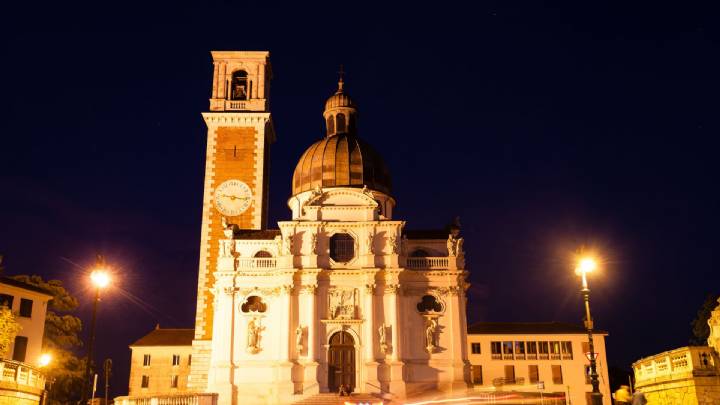
The Sanctuary of the Madonna di Monte Berico is one of the most significant symbols of Vicenza, valued both for its spiritual significance and for its artistic heritage, as well as for the view it commands over the city and the surrounding mountains. Located on the Monte Berico hill, the sanctuary offers spaces dedicated to meditation. Adjacent to the sanctuary is the Giardino della Vittoria, a small park designed for inner reflection; on fine days, you can find people painting, strolling and enjoying the view of Vicenza against a backdrop of mountains. To stay in close contact with nature, a short distance away you can reach the Lake Fimeon area, where a variety of excursions can be enjoyed through wooded areas and hamlets, some of which are barrier-free and easily accessible.
For further information: https://colliberici.it/it/attivita/itinerari
Also worth a visit are the village of Zovencedo, which perched on a hilltop offers a spectacular panoramic view, and the Casa Rupestre La Sengia, nestled in the woods near the main square. Since the Colli Berici hills yield a limestone rock widely used in the architecture of this area, many open-air quarries can be found here; one of these gave rise to La Sengia dei Meoni, a house carved into the rock inhabited until the 1960s, now transformed into a museum still furnished with the original furniture. Nearby, you can also visit the Museo della Pietra di Vicenza, which tells the story of the bond between the people of this land and stone working. A local cooperative organises its opening times and guided tours.
For information: https://www.comune.zovencedo.vi.it/
The Sanctuary of the Holy House of Loreto, the underground city of Camerano and Recanati, in Marche
The Sanctuary of Loreto, in Marche, is one of the most famous Marian sanctuaries in the world, dedicated to the Lauretan Virgin, also known as the Black Madonna. The basilica, a masterpiece of Italian Gothic-Renaissance architecture, was designed by great masters such as Giuliano da Sangallo and Bramante. Inside stands the Holy House, the small dwelling of Mary which, according to tradition, was carried by angels to Loreto. Recent documentary discoveries and archaeological excavations in Nazareth and beneath the sanctuary support the theory that the Holy House was in fact transported by sea aboard a ship, thanks to the involvement of the Angeli family, nobles from Epirus. Among the experiences not to be missed is the Holy Staircase, a flight of 330 steps to be climbed in prayer, leading to the basilica and offering a panoramic view over the Riviera del Conero. Not far from the sanctuary lie the Grotte di Camerano – the Underground City of Camerano, an actual city, likely dating back to medieval times, that unfolds beneath the ground. The solemnity of its various chambers suggests they may have served as places of worship, veritable underground churches, or meeting spaces.
To organise a visit, consult the official website:
https://www.operaturismo.it/grottedicamerano/
Visitors to this area should not miss a stop in Recanati, the birthplace of Leopardi, which now offers a new augmented reality tourist trail, freely accessible via smartphone, immersing visitors in an atmosphere dominated by Leopardi's artistic presence.
Information here: https://www.recanatiturismo.it/geniusloci/
The Upper Basilica of St Francis of Assisi, the Sacred Wood and Monte Subasio, in Umbria
The Basilica of St Francis in Assisi, Umbria, is the principal sanctuary dedicated to St Francis and one of the most important Christian pilgrimage sites in the world. In 2000, the complex, which also includes the Sacro Convento, was inscribed on the UNESCO World Heritage List. Right next to the Basilica of St Francis is the entrance to the FAI Bosco di San Francesco, a 64-hectare natural area that the FAI – Fondo per l'Ambiente Italiano (Italian Environment Fund) – has restored and reopened to the public. Here you can walk trails immersed in nature amid woods and olive groves, evoking the Franciscan spirituality that inspired the artist Michelangelo Pistoletto to create his work "Terzo Paradiso" (Third Paradise), a symbol of reconciliation between man and nature. The trails running alongside the Tescio stream lead to the ancient Benedictine monastery of Santa Croce, with its Romanesque church now serving as the FAI's information point, a medieval mill, and a broad clearing overlooked by a medieval tower, where Maestro Pistoletto's land art piece "Terzo Paradiso" stands.
For information, visit the website:
https://fondoambiente.it/luoghi/bosco-di-san-francesco
Another destination in close contact with nature is Monte Subasio, a veritable paradise for trekking enthusiasts; among the most evocative routes is one that follows the Fosso Marchetto upstream, discovering gorges carved into the rock by the stream. The Monte Subasio Park is also renowned for its spontaneous orchid blooms.
For information on the routes available, visit the website:
https://www.montesubasio.it/
The Sanctuary of Santa Maria del Fonte and the Lorenzo Rota Botanical Garden, in Lombardy
The Sanctuary of Santa Maria del Fonte, also known as the Sanctuary of Caravaggio, in Lombardy, is a place of great significance for Marian devotion, dating back to the 15th century. The basilica, surrounded by a portico with around 200 arches, offers ample space for pilgrims. Here, in an underground corridor, lies a spring of water believed to be miraculous, from which pilgrims may draw. The sanctuary is set within an extensive park with porticoes housing the Stations of the Cross, creating an ideal setting for prayer and reflection. Less than an hour's drive from the sanctuary lies the Astino Valley, which in 2021 was awarded the National Landscape Prize by the Ministry of Culture, along with its ancient monastery. A circular walk allows visitors to take in the natural beauty of the area and reach the Lorenzo Rota Botanical Garden, housed in a former monastery alongside a small church.
Further information here: https://www.ortobotanicodibergamo.it/
The Sanctuary of Oropa, the botanical garden, Burcina Park and Lake Mucrone, in Piedmont
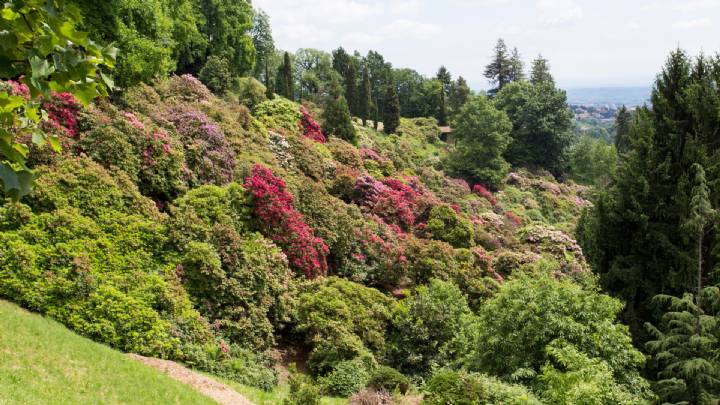
The Sanctuary of Oropa, located in the Biella mountains in Piedmont, is one of the oldest and largest Marian complexes in Europe. Renowned for its statue of the Black Madonna, the sanctuary, situated at an altitude of over 1,000 metres, is surrounded by a striking Sacro Monte (Sacred Mountain) made up of nineteen votive chapels depicting the life of the Madonna; this complex has been recognised as a UNESCO World Heritage Site. For those wishing to immerse themselves in nature, not far away lies Lake Mucrone, situated on the mountain of the same name, reachable from Oropa by the Mucrone cable car and an easy path, or by a two-hour walk. There is also the botanical garden of Oropa, where you can wander freely or follow guided routes to discover numerous plant species, including peonies, arnica montana and other typically Alpine species. For those wishing to immerse themselves further in nature, not far away lies the Burcina Park "Felice Piacenza"; a historic garden dating back to the 1800s, located within the municipalities of Biella and Pollone, right at the foot of the Biella foothills. The walk takes in a route between a romantic little lake and wooded areas.
For further information, visit the websites: https://www.parcoticinolagomaggiore.com/it-it/aree-protette/servizi/riserva-naturale-parco-burcina-felice-piacenza and
https://www.gboropa.it/Informazioni/Informazioni.htm 


 App Camperonline