At this year’s Düsseldorf Caravan Salon, TELECO is presenting a new range of Lithium batteries (LiFePO4) for recreational vehicles that can provide exceptional performance for camper tourism enthusiasts. The offer includes two series: TLI Extra and TLI Extra Pro.
The growing presence of increasingly sophisticated electronic equipment, and the desire of many camper users to enjoy the same comforts on holiday as they do at home, has created a greater need for energy. The efficiency and performance of service batteries have therefore become fundamental factors for ensuring energy autonomy. After extensive experimentation and testing in its Italian laboratories, Teleco will be presenting two series of Lithium batteries (LiFePO4) for recreational vehicles, the TLI Extra and TLI Extra Pro, at the Düsseldorf Caravan Salon.
What are the advantages of a lithium battery compared to a normal lead-acid battery?
An important factor is that during discharge, the voltage remains constant for much longer, down to a 5% state of charge. At this point, the battery management system (BMS), included in both the TLI Extra and the TLI Extra Pro, intervenes and disconnects the batteries. Although they are 95 percent discharged, the batteries will not be damaged. They are ready for charging, which is much faster than for conventional batteries: they can even reach a full charge in less than an hour. This is also possible when charging with the vehicle alternator. They can be charged quickly, even with high charge rates, and can also be discharged quickly without damaging the cells. This characteristic makes them ideal for use with inverters when using devices with heavy current consumption (coffee machines, microwave ovens, hair dryers, toasters, etc.). Lithium batteries can also bear thousands of charge cycles, reaching up to 5,000 cycles, practically 10 times more than conventional lead batteries. They have a very low self-discharge rate and can therefore be left unattended for months. They are also totally maintenance free, weigh up to 70% less than conventional batteries, have a more compact shape and can be installed in any position. They are safe, thanks to the use of lithium iron phosphate (LiFePO4 or LFP) ion technology, non-toxic, do not emit dangerous fumes and cannot explode or catch fire. Lithium batteries are more eco-friendly as they use low environmental impact materials: they do not contain lead or other harmful materials, in accordance with the EU’s RoHS Directive.
TLI Extra series
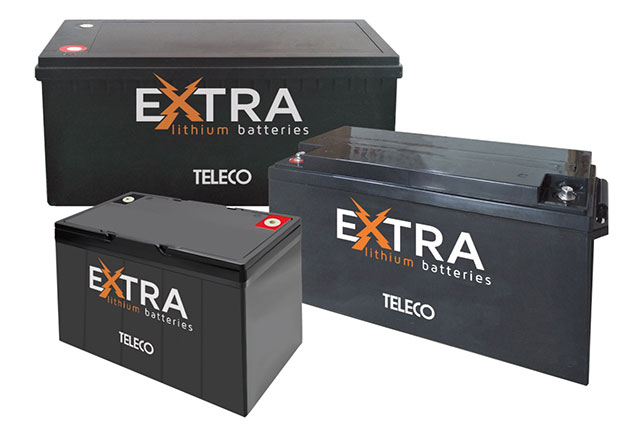
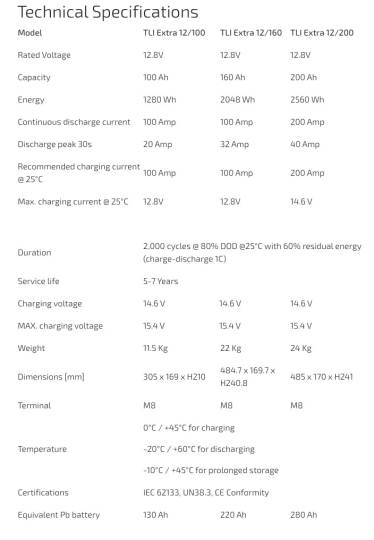
The TLI Extra batteries are equipped with an extremely reliable internal “Battery Management System” (BMS), which ensures the battery’s safety and efficiency, monitoring the temperature of the electronics and the cells, and controlling the voltage of each individual cell to obtain the best balance. The TLI Extra series offers three models: the TLI EXTRA 12/100 (100 Ah), the TLI EXTRA 12/160 (160 Ah) and the TLI EXTRA 12/200 (200 Ah).
TLI Extra Pro Series
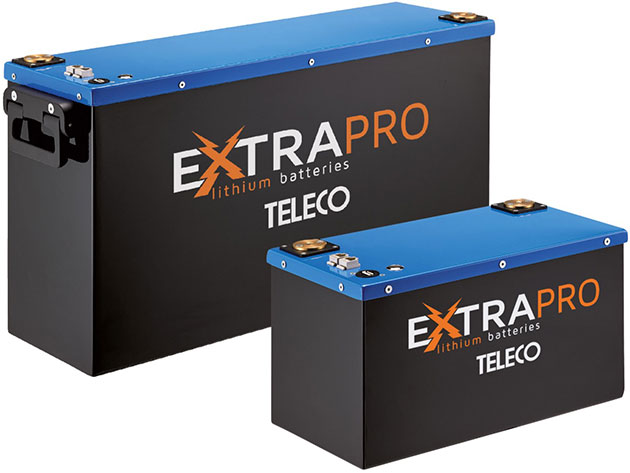
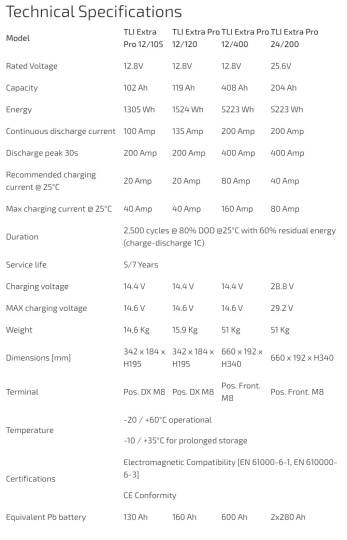
The TLI Extra Pro (professional) batteries are distinguished from the other lithium batteries on the market by their high energy density: with the same weight and size they store a much higher quantity of energy. TLI Extra batteries contain a sophisticated “Battery Management System” (BMS), which manages the voltage of each individual cell, both during charging and discharging, thereby increasing their life. The BMS also ensures protection from failures due to high temperatures, overcharging and excessively deep discharging.
The features of the BMS include:
- Integrated CAN-bus communication
- BMS management electronics integrated with programmable I/O
- Integrated safety relay
- External protection fuse
- Auto-sleep mode and wake-up button
- USB port for diagnostics and fault log
- Control panel (optional) with a charging status display and storage mode entry/exit command
The BMS also ensures protection from failures due to high temperatures, overcharging and excessively deep discharging.
Guaranteed quality:
- Individual quality control for each production step
- Assembled in ITALY
- Selected latest-generation components


 App Camperonline