The first stage of the Retrofitting Training organised by AL-KO Vehicle Technology Electronics took place in Verona on 10 February 2026,
with the participation of AL-KO Vehicle Technology for the mechanical side.
The event, hosted not far from the
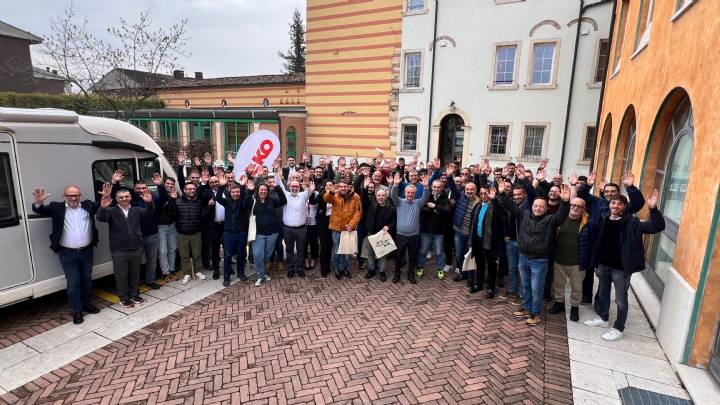
Premium Assistance Centre in Castel D’Azzano, brought together more than
80 professionals and over
50 dealers from central and northern Italy, confirming the strong interest in one of the most strategic topics for the RV sector today:
retrofitting.
This term means far more than a simple technical update: it means bringing vehicles into the present, integrating intelligent technologies capable of improving safety, efficiency, comfort and sustainability.
The training organised by
AL-KO Vehicle Technology Electronics was not just a technical course, but a genuine overview of how the approach to recreational vehicle electrical systems is changing. The key concept that emerged is simple: today,
retrofitting doesn’t mean replacing a faulty component, but
upgrading the vehicle and bringing it into the digital era. The starting point is updating traditional systems – distribution boards and control panels – with new digital solutions. By replacing older components with advanced systems (a new control board, colour display panel and communication gateway), even a motorhome with many years behind it can be transformed into a connected smart hub.
At the heart of the system is the ONDA Connectivity platform: an IoT infrastructure that allows the main on-board functions to be managed and monitored from a smartphone (via Bluetooth or Wi-Fi). Not just lights and appliances, but also battery status, tank levels, internal and external temperature, geolocation and vehicle inclination. In practice, what was previously scattered across various devices is now centralised in a single interface, both on the control panel and in the app.
One of the aspects most appreciated during the course was the practical approach: the retrofit has been designed to be installed without overhauling the existing system. Dedicated adaptive wiring harnesses allow the distribution board to be replaced with minimal work, mostly limited to the wiring connectors.
The objective is clear: to make the operation sustainable for the workshop and accessible for the end customer, turning the intervention into a high-value-added technological upgrade.
The system is not limited to proprietary devices: through the CI-BUS port, it is also possible to integrate the most common heating and air conditioning systems, fridges and batteries from various brands. AL-KO VTE intends to progressively expand this ecosystem.
On-board energy management
Considerable attention was also given to energy management: new compact, fan-free battery chargers, DC-DC converters for vehicles with smart alternators, pure sine wave inverters and a complete range of high-efficiency solar panels, including the latest BackContact panels.
On the storage front, the partnership with Varta introduces high-performance lithium batteries, with high current output, integrated Bluetooth and readiness for integration into the connected system.
The message is clear: digitalisation cannot be separated from advanced, consistent energy management.
The training highlighted how retrofitting now represents a strategic lever for the market. It’s not just about updating a system, but about extending the vehicle’s working life, increasing its perceived value and bringing it into a smart dimension.
AL-KO VT: suspension, chassis and stability
Alongside the digitalisation of the electrical system, the training also dedicated space to the mechanical side of recreational vehicles, with a focus on the role of the chassis and suspension in driving quality and vehicle safety.
The discussion covered ACS reinforced springs. In the case of Ducato-based vehicles, the front axle comes as standard with coil spring suspension.
In the aftermarket, it is possible to fit AL-KO springs specifically calibrated to the actual weight on the front axle. The result is not just a higher or firmer vehicle, but above all a more stable, quieter and less tiring drive.
On vehicles with an AL-KO chassis, torsion bars are also found, a distinctive feature compared with the classic leaf-spring chassis, which require maintenance. Periodic greasing (at least once a year or every 20,000 km) should be carried out to ensure durability and correct operation over time.
The discussion then moved on to HY4 hydraulic levelling jacks. Each jack is a self-contained unit with an integrated pump and reservoir, avoiding the need for long pipework running along the chassis. Installation takes place entirely underneath the vehicle, without taking up any interior space. Each jack works independently, ensuring balanced load distribution and effective stabilisation even on uneven ground.
The event concluded outdoors, aboard a Carthago motorhome, where all those present were able to check the expert installation of AL-KO Vehicle Technology and AL-KO Vehicle Technology Electronics accessories, and test the ONDA Connectivity app, the control panel and the HY4 jacks, experiencing their functions and performance first-hand.
The day demonstrated that the future of the motorhome can also be built in the workshop, through retrofit work that involves the entire balance of the vehicle: from the electrical system to energy management, right through to suspension, set-up and stabilisation.
It is the integration between digital solutions and mechanical components that makes the difference, transforming a traditional vehicle into an advanced system, more stable on the road, more comfortable when parked and smarter in managing its resources.
For the end user, this means driving a motorhome that is safer, more efficient and more connected, but also more balanced and more enjoyable to live with. The motorhome of the future, after all, could well be the one you already own: all it takes is an upgrade capable of bringing technology and engineering together in a single vision.


 App Camperonline